
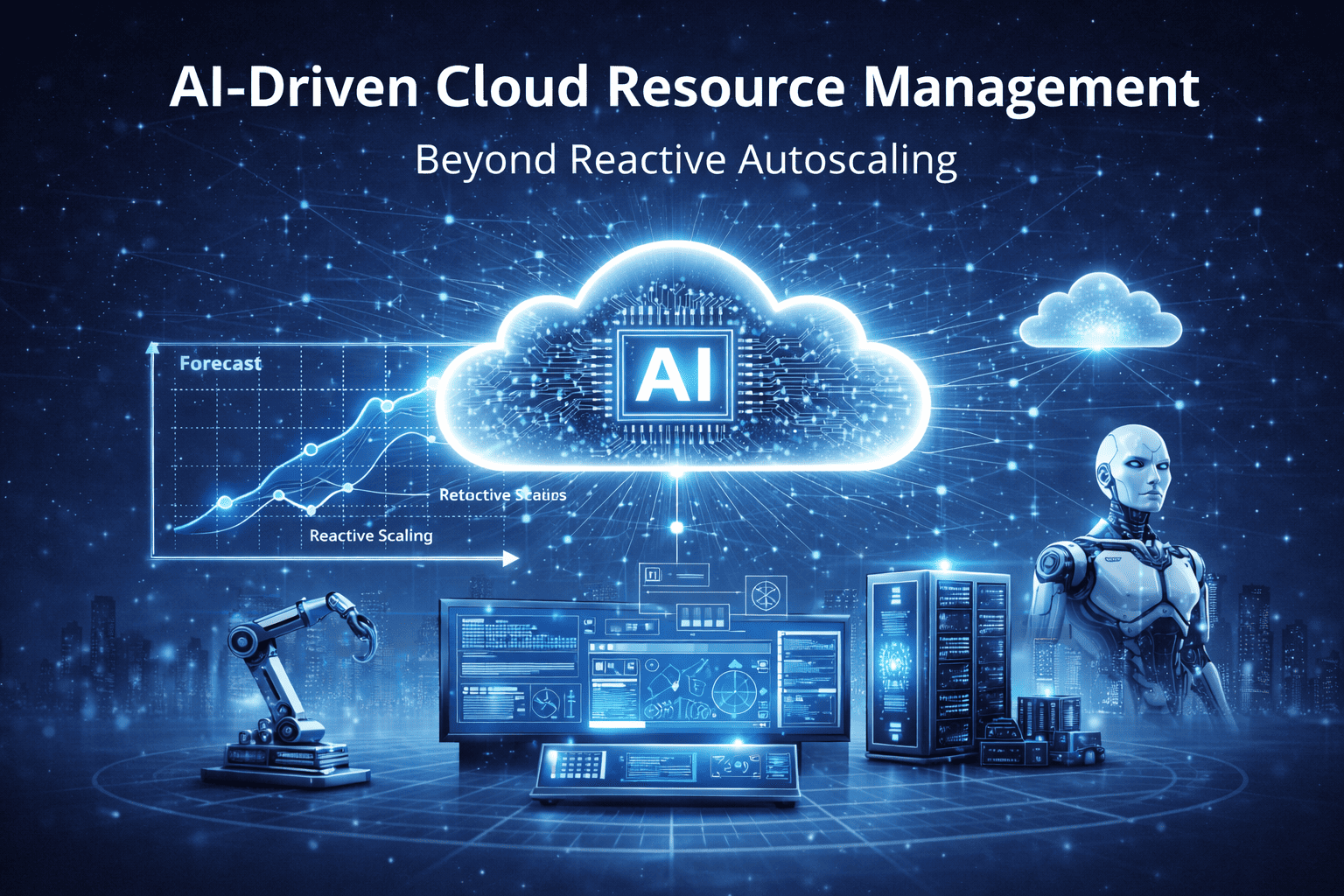
Cloud computing has fundamentally changed how computing resources are provisioned and consumed. Yet, despite advances in virtualization, containerization, and orchestration, many cloud systems still rely on reactive autoscaling mechanisms—rules that respond only after changes in workload have already occurred.
As workloads become more dynamic and service expectations more stringent, this reactive paradigm is increasingly inadequate. The future of cloud resource management lies in AI-driven, predictive, and adaptive systems that move beyond simple threshold-based responses.
The Limits of Reactive Autoscaling
Traditional autoscaling strategies typically operate on predefined rules:
- Scale up when CPU usage exceeds a threshold
- Scale down when utilization drops below a limit
While straightforward, such approaches suffer from several inherent limitations.
Delayed Response
Reactive systems respond after a workload change has occurred. This delay can lead to:
- Temporary service degradation
- SLA violations
- User-perceived latency spikes
In latency-sensitive applications, even short response delays can be costly.
Over-Provisioning and Under-Utilization
To compensate for uncertainty, reactive systems often provision excess resources. This results in:
- Increased operational cost
- Inefficient resource utilization
- Poor energy efficiency
These inefficiencies accumulate significantly at scale.
Inability to Handle Complex Workload Patterns
Modern cloud workloads exhibit:
- Periodicity
- Bursty behavior
- Sudden, non-linear changes
Rule-based scaling struggles to adapt to such patterns without extensive manual tuning.
From Reaction to Prediction
AI-driven cloud resource management introduces a shift from reaction to anticipation. Instead of waiting for utilization metrics to cross thresholds, predictive systems aim to forecast future demand and adjust resources proactively.
This transition requires answering key questions:
- What workload patterns are likely to occur next?
- How confident is the prediction?
- What is the cost-performance trade-off of acting early?
Machine learning models—particularly time-series forecasting and reinforcement learning approaches—enable systems to reason about these questions dynamically.
AI as a Decision-Making Layer
In AI-driven cloud systems, intelligence is not limited to forecasting. It becomes a decision-making layer that balances multiple objectives:
- Performance guarantees
- Cost efficiency
- Resource availability
- SLA compliance
Rather than optimizing a single metric, intelligent controllers evaluate trade-offs under uncertainty. This multi-objective perspective distinguishes AI-driven management from heuristic-based approaches.
System-Level Challenges in Intelligent Cloud Management
While AI promises significant benefits, integrating it into cloud resource management introduces new system-level challenges.
Data Quality and Observability
Accurate predictions depend on high-quality monitoring data. Incomplete or noisy signals can degrade model performance and lead to poor decisions.
Model Generalization
Cloud environments are heterogeneous. Models trained under specific conditions must generalize across:
- Different workloads
- Infrastructure configurations
- Application behaviors
Failure to generalize can make AI-driven systems brittle.
Trust and Control
Operators must trust AI recommendations without losing control. This requires:
- Explainable decision logic
- Safe fallback mechanisms
- Clear performance guarantees
AI-driven systems must therefore be designed to be assistive rather than opaque.
Distributed Intelligence in Cloud Management
As cloud platforms evolve toward hybrid and multi-cloud deployments, centralized decision-making becomes increasingly complex. Distributed intelligence—where local components make informed decisions while coordinating globally—offers a scalable alternative.
Such architectures:
- Reduce decision latency
- Improve resilience
- Allow localized optimization
This aligns naturally with federated and decentralized learning paradigms, reinforcing the broader shift toward distributed AI systems.
Rethinking Success Metrics
Evaluating intelligent cloud resource management requires moving beyond traditional metrics such as average utilization.
Key evaluation dimensions include:
- Cost savings over time
- Frequency and severity of SLA violations
- Adaptability to unseen workloads
- Stability under uncertainty
These metrics reflect the real operational impact of intelligent decision-making.
The Road Ahead
AI-driven cloud resource management will not replace existing mechanisms overnight. Hybrid approaches—combining predictive intelligence with traditional safeguards—are likely to dominate in the near term.
However, the trajectory is clear. As cloud systems become more complex and performance expectations rise, intelligence must shift from reactive control to anticipatory orchestration.
Conclusion
The evolution of cloud resource management mirrors the broader evolution of AI systems: from static rules to adaptive, learning-driven decision-making. Moving beyond reactive autoscaling is not merely an optimization—it is a necessary step toward building cloud infrastructures that are efficient, resilient, and responsive to future demands.
Understanding this transition is essential for researchers, architects, and practitioners designing the next generation of intelligent cloud platforms.